Showing posts sorted by date for query lancet. Sort by relevance Show all posts

Wednesday, April 23, 2025

The Lancet Adds Two New Risk Factors for Alzheimer's

The Lancet is one of the premier scientific journals in medicine.  We wrote back in 2022 of the results of the work of the Lancet commission on dementia.  With the unlikelihood that an outright cure for Alzheimer's disease would appear anytime soon, the commission's report highlighted a list of the modifiable lifestyle and other factors that influence the development of the disease.  They will be familiar to anyone who has read Beating the Dementia Monster or who follows this blog.  They were:

- physical inactivity,
- excess alcohol consumption,
- obesity,
- smoking,
- hypertension,
- diabetes,
- depression,
- traumatic brain injury,
- hearing loss,
- few years of education,
- social isolation, and
- air pollution.

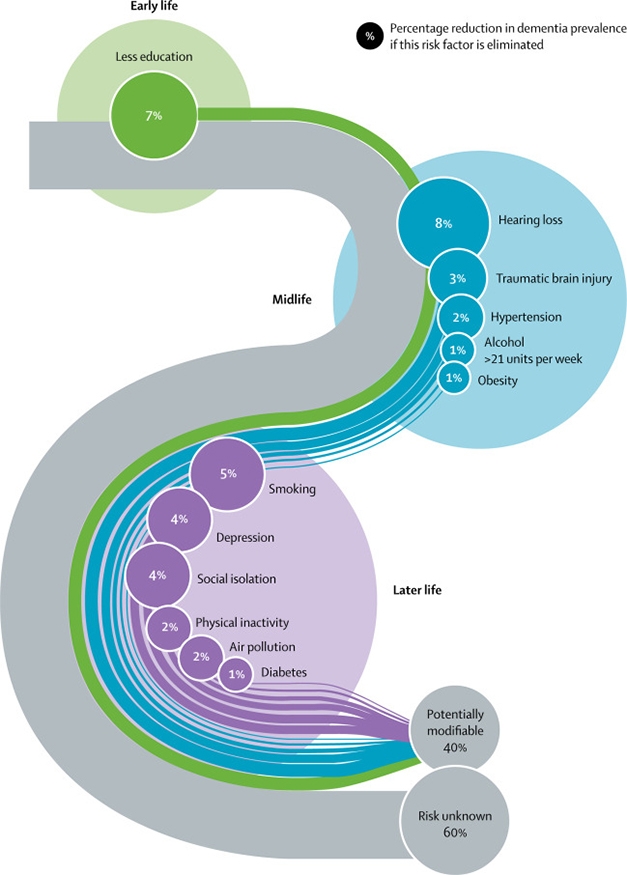
The 2022 report included this graphic which showed how the different risk factors map out over someone's lifetime.  Note their conclusion that 60% of the total factors are simply unknown.  Nevertheless, 40% are potentially modifiable - things you can do to affect your susceptibility to the disease.

Then, just last year, the commission released a new study which updated their conclusions.  They noted that, as people live longer, the number of people who live with dementia continues to rise.  But they also noted that, as the age-specific incidence decreases in high-income countries, there is a need to identify and implement prevention approaches.  So much of the report's recommendations focus on changes in governmental policy.

The main takeaways from the new report (after acknowledging the original report) is the addition of two new risk factors: vision loss and high LDL cholesterol (i.e., "bad cholesterol").  But they also said, "The potential for prevention is high and, overall, nearly half of dementias could theoretically be prevented by eliminating these 14 risk factors. These findings provide hope."  They also said, "Although change is difficult and some associations might be only partly causal, our new evidence synthesis shows how individuals can reduce their dementia risk."

I am still waiting for the Alzheimer's Association Facts and Figures Report for 2025.  In the past, this has been a rich resource, even richer than the Lancet's dementia commission reports.  But they still haven't published it.  You can, however, add it to your "wish list" -- which I did.  I presume this means they're still working on it, and we'll see it soon.  In the past, it's been available during the first week in March.  Oh, and, here's a first: I'll need to pay for it now.  Not free anymore.  But I can afford the $7.95.

Friday, March 21, 2025

Cutting the Risk of Young Onset Alzheimer's in Half?

In Beating the Dementia Monster, we wrote that "young onset" or "familial" Alzheimer's disease is caused by three unusual genes, and these almost surely guarantee that you will develop the disease, perhaps as young as in your 30s.  We also wrote in 2022 that the testing of the monoclonal antibody gantenerumab was discontinued by Roche because it appeared to be ineffective against familial or any form of Alzheimer's.  

As with the other monoclonal antibodies (think Kisunla and Leqembi), the treatment is able to remove the plaques of amyloid beta from the brain.  Since development of these plaques is part of how we define the disease, logic said that getting rid of them should slow or even stop development of the disease.  We call this the amyloid hypothesis.  But, in the case of gantenerumab, it didn't.  And so Roche gave up on it.

But hold the presses!  There's a new study finding that gantenerumab can actually cut the incidence of the development of familial Alzheimer's in half!  

So what's different this time?  Well, according to a study published in the April 2025 issue of The Lancet, the key is start early.  Like, decades early.  We know that the disease begins as much as 20 years before the first symptoms, so start the antibody treatment then.

How do you know that it's 20 years before you will develop memory loss and other symptoms of Alzheimer's?  With "old onset" or "sporadic" Alzheimer's, that's a challenge.  But, since familial Alzheimer's is so easily recognized in someone's DNA analysis, and since family member with one of the genes all tend to develop symptoms at about the same age, this becomes a fairly straightforward task. 

The study by researchers largely associated with Washington University, St. Louis involved 73 people with one or more of the genes responsible for familial Alzheimer's.  This genetic makeup all but guaranteed that they would develop Alzheimer’s disease symptoms in middle age.  For a subgroup of 22 participants who had no cognitive problems at the start of the trial and who received the drug the longest (an average of eight years) the treatment lowered the risk of developing symptoms from essentially 100% to about 50%.  Pretty amazing.

A couple of things though.  This was over an eight-year period.  If they continue the treatments, we still don't know if any of the participants will eventually develop memory loss or other symptoms of the disease.  Also, monoclonal antibody treatments can lead to micro-hemorrhaging in the brain, and two study participants had to be removed because of this.  So part of the treatment is administration of regular MRIs to watch for the development of brain abnormalities.  And because work with gantenerumab had been discontinued, the study treatment was shifted from gantenerumab to Leqembi.  Leqembi appeared on the scene late in the study, but has been shown to produce better results than gantenerumab.

So it may be that this discovery will only have value for people likely to develop familial Alzheimer's.  We can't accurately predict those who will develop sporadic Alzheimer's (after age 65), so we won't know if or when to begin treatment.  On the other hand, the ability to treat people who might develop the disease when they still have young families could be a real breakthrough.

I appreciate the comment from an unknown reader of this blog who brought this news to my attention.

Thursday, August 22, 2024

My college classmate, Roy, sent me a link to this article in The Economist. It refers to an article in the prestigious journal, The Lancet, updating us on where medical science is at with respect to lifestyle and development of dementia.  It's an update to an article we discussed before that endeavored to say how much each modifiable lifestyle factor affects the probability that we will develop dementia.  Of course, the researchers who wrote the article emphasized all elements of the Dementia Toolkit and then added a couple more.  And this update adds two more as well.

The new factors in this updage were high LDL cholesterol in mid-life and untreated vision loss in later life.  The correlation with LDL is quite strong, although the correlation with vision loss is weaker.  

In discussing the MIND diet, we noted previously that there's an association between consuming saturated fats (such as in cheese and red meat) with development of dementia.  (This is in spite of the fact that the association of dietary cholesterol and cardio-vascular disease is much weaker than previously thought.)  So maybe that's related to the newer finding on LDL.  But the vision finding is quite interesting -- and I think it goes with the previously recognized association of hearing loss with dementia.  We're told that the hearing loss factor is associated with social isolation.

So my take is that, when human beings connect with each other in relationship, the brain is strengthened.  Therefore, factors impairing our ability to communicate and otherwise socialize with other people affects brain health negatively -- they contribute to the probability someone might develop dementia.  So when you have trouble hearing other people, it makes it harder to form or exercise the human bonds that strengthen our brains.  It looks to me like the same thing applies to vision loss.  When you have trouble seeing others, it interferes with your ability to socialize with them.  And that encourages the development of dementia.

Tuesday, July 19, 2022

More evidence: It's all about lifestyle!

Forty percent of dementias in the United States are preventable.  When I tell people that, they look shocked.  Most people have been told that it's all in your genes, and your genetic makeup is your death sentence.  But readers of this blog know this is just not true.  In Beating the Dementia Monster, we listed the modifiable lifestyle factors that are the biggest drivers of Alzheimer's disease and discussed how you can deal with each.  

About two years ago, we discussed an article in the prestigious journal, The Lancet, which was regarded as the definitive analysis of lifestyle and dementia.  It was the work of a commission set up to evaluate what can be done to prevent dementia.  It found that 40% of dementias were preventable, and 12 risk factors could be modified to prevent dementia.  These are:

- physical inactivity, 
- excess alcohol consumption, 
- obesity, 
- smoking, 
- hypertension, 
- diabetes, 
- depression, 
- traumatic brain injury, 
- hearing loss, 
- few years of education, 
- social isolation, and 
- air pollution.  

The commission determined that hearing loss, education, and smoking are most significant.

The evidence supporting the Lancet Commission's conclusions continue to pour in.  A recent study published in JAMA (formerly Journal of the American Medical Association) came to very similar conclusions.  It was entitled "Variation in Population Attributable Fraction of Dementia Associated With Potentially Modifiable Risk Factors by Race and Ethnicity in the US."  The research team was led by Mark Lee, a PhD candidate at the University of Minnesota.

Lee began with the same risk factors from the Lancet Commission report and then determined what portion of dementia in different cohorts is explained by modifiable risk factors.  Cohorts were Hispanic, non-Hispanic White, non-Hispanic Black, and non-Hispanic Asian.  In all cohorts, high blood pressure, obesity, and lack of exercise were most closely correlated with dementia.  

Also, lifestyle differences between cohorts corresponded to different levels of risk due to modifiable factors.  The study used self-reporting in survey responses to establish the cohorts.  Based on the survey responses, the study attributed the 12 risk factors to 46.7 percent of dementia risk in Hispanic, 45.6 percent in Black, 39.4 in non-Hispanic whites, and 35.8 percent in non-Hispanic Asian populations. 

But there's a problem with these 12 risk factors.  Many of them correlate with each other in ways that suggest they are not unique.  We've said before that there may be commonality between hearing loss and social isolation -- hearing loss may simply be a form of social isolation.  And then physical inactivity, obesity, hypertension, and diabetes are often found together.  Fewer years of education was more characteristic of some cohorts than others.  Do these commonalities indicate that they are all manifestations of something underlying a given set of correlated risk factors?

No matter how you slice and dice it, if you want to do your best to prevent or deal with Alzheimer's disease, making good lifestyle choices is your best bet.   And the dementia toolkit we provide in Beating the Dementia Monster is your best guide on making the best choices.

Wednesday, March 23, 2022

Hearing loss, cataracts, and dementia

Back in December, we wrote about research finding that people who had cataract surgery had a 30% lower probability of developing dementia.  I speculated that there might be a relationship between that and a higher incidence of dementia among people with hearing loss.  Recently, other researchers are seeing a similar connection.  In August 2020, we wrote about a Lancet commission report identifying both hearing loss and loss of vision as modifiable risk factors for dementia.  Combined hearing and vision problems may increase the risk of dementia by 50%.  The hope is that aggressively addressing both of these would significantly lower the incidence of dementia.  

Why should such a correlation exist?  One idea is that sensory dysfunction interferes with social connection which is important to resisting dementia.  If you can't hear people or can't see them well you are likely to simply withdraw socially.  And that's deadly.  

But recent research suggests a broader problem.  Failing to control for sensory dysfunction may be skewing statistics about the prevalence of the dementias.  We wrote earlier this week about the Alzheimer's Association Facts and Figures Report.  The report devoted space to how difficult it has been to accurately count people afflicted by different dementias.  

This week's ALZForum had this article on the correlation between sensory dysfunction and dementia.  One thing they noted is that people who don't see or hear well don't do well on cognitive tests, especially tests involving language and memory.  So the apparent correlation may be partly due to over-counting people with dementia simply because they don't test well.

Monday, September 21, 2020

Can contaminated surgical instruments spread Alzheimer's disease?

 Now there's a scary thought!  

A few years ago, some researchers found reasons to believe that amyloid seeds could be carried from one neurosurgery patient to another via surgical instruments.  This implies that contaminated instruments could transmit Alzheimer's disease between patients undergoing neurosurgery.  This in turn led to some alarming headlines.

Now, according to a recent white paper in the British medical journal The Lancet, this risk may exist, but it requires further study to be understood.  The white paper was the product of a working group gathered to investigate the risk.  It was analyzed in this week's Alzfourm.  

The working group concluded that there was little evidence that amyloid seeds could be transmitted during neurosurgery, but the risk shouldn't be dismissed.  Instead, it warranted a long-term epidemiological study.  It also recommended that surgical instruments used for neurosurgery in children be segregated from those used for adults.

If the seeds are actually transmitted, they would come from surgery involving older adults with evolving presence of beta amyloid in their brains.  Once transmitted to a younger person, the seeds would likely take 20 years to develop into a stage of Alzheimer's disease involving cognitive impairment.  Therefore, transmission from one older adult to another would be of much less consequence than transmission from an older adult to a young person. 

One person commenting on the article noted that there are a lot of serious risks that must be considered before any neurosurgery, and the benefits must outweigh those risks.  He suggested that, in comparison, the risk of developing "cerebral amyloid angiopathy" from contaminated instruments is minimal.  Cerebral amyloid angiopathy is a condition involving the familiar beta amyloid, and it is often, but not always, associated with Alzheimer's disease.  The commenter also suggested that further epidemiological study is warranted.  

Thursday, August 13, 2020

We go from 35% of dementia is preventable to 40%

 The Lancet Commission is a group commissioned by the Lancet to analyze dementia prevention, intervention, and care.  As we've said before, the Lancet is one of the oldest and most prestigious medical journals in the world that publishes peer reviewed research.  In 2017, the commission published the results of their work, concluding that 35% of dementia cases were preventable.  

But at this year's Alzheimer's Association International Conference (which we discussed extensively two weeks ago), the commission updated their conclusion to estimate that 40% of dementias are preventable.  What changed?  They added excessive alcohol consumption, air pollution, and traumatic brain injury (TBI) to their list of preventable causes.  We have previously addressed alcohol and air pollution as causes of dementia in this blog, and we discuss TBI in Beating the Dementia Monster.   

The commission provided an interesting but somewhat cryptic graphic to show the role of each of twelve known and suspected potentially modifiable risk factors for dementia.  What's interesting about the graphic is how they show the influence of the factors based on the stage of life in which they occur.  Educational achievement in early life is an important factor with the potential to eliminate 7% of cases, while there are five factors in mid-life and six factors in later life.

Some people at the conference were confused by the percentages assigned to each factor.  According to the commission, the numbers corresponded to the per cent reduction in cases if the factor is eliminated.  You can read more here.


Friday, June 19, 2020

Loneliness

In Beating the Dementia Monster, we discussed the role of social activity in fighting Alzheimer's disease.  Studies have found that, for whatever reason, lonely people decline faster than people with rich social lives.  It's not clear that lonely people are more likely to develop Alzheimer's disease, but the evidence is that one's capacity to oppose neurodegeneration, once it has begun, is impeded by loneliness.

In May, I posted about a friend with dementia who died in a senior living facility.  The lockdown had been in place for a couple of months, and he would have been very lonely.  His dementia was serious, but he still responded strongly to me when I visited him.  He was very much an extrovert, and we enjoyed time together -- I as much as he.

The Lancet is perhaps the oldest medical journal publishing peer-reviewed medical research.  In February 2018 they published some research on the physiological effects of loneliness -- "The Growing Problem of Loneliness."  The research found a 26% increase in the risk of premature death among lonely people, although they acknowledged difficulties in measuring who is lonely.  And it expressed alarm with how pervasive loneliness is becoming in our culture.

I was directed to the Lancet by an article in c|net regarding how loneliness affects us physiologically -- "How loneliness could be changing your brain and body."  The article explored several aspects of loneliness and the brain, including its relationship to Alzheimer's disease.  It's well known that sources of stress, such as loneliness, change the chemistry of the body, usually in negative ways.

According to the article, loneliness and the hormones it promotes do not appear to initiate events leading to the plaques and tangles of Alzheimer's disease.  Nevertheless, chemistry changes resulting from loneliness can change which genes are "expressed," meaning which genes will be used to produce different proteins.  Some of the proteins promoted by the chemistry of loneliness may be involved in inflammation.  As we have said so often before, inflammation can encourage an existing case of Alzheimer's disease to proceed more rapidly.

My Video on Molecular Biology

As I wrote earlier, I've run out of gas with respect to posting new insights on Alzheimer's research. But I'm still busy (and st...